
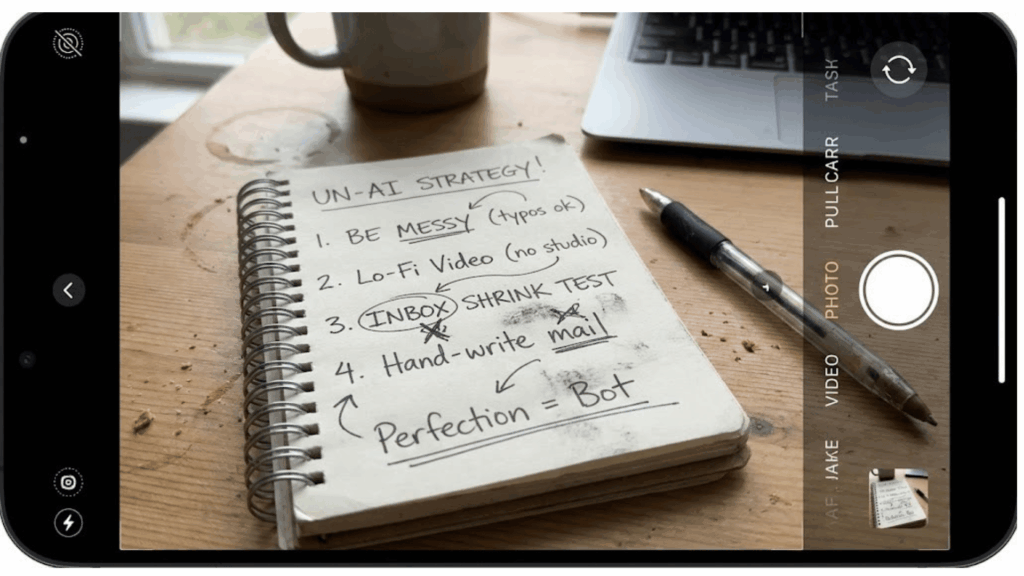
Because we’re all getting used to how AI makes “perfect” content cheap and easy, “imperfect” or “high-effort” content becomes a luxury signal that proves a human is behind the brand.
And when you become more human (especially today) you get attention!
These strategies rely on the principle of “Signaling Effort.”
1. The “Lo-Fi” Video Strategy
The Theory: High-production video (perfect lighting, stock b-roll, smooth cuts) now feels like “content farm” slop.
AI can generate smooth stock footage easily. It cannot easily generate a shaky, handheld video of a founder walking through a warehouse.
The Tactic:
Ditch the Studio: Film updates while walking, in your car, or in a “messy” office.
Bad Audio is Okay: Actually, it’s a signal. Using the phone microphone instead of a perfectly compressed studio mic signals “I am doing this right now, for you.”
No B-Roll: Do not cover your talking points with stock video of “business people shaking hands.”
Keep the camera on your face. Eye contact is high-trust; stock footage is low-trust.
2. “Do Things That Don’t Scale” (The Postal Service Hack)
The Theory: Digital inboxes are flooded with AI spam. Physical mailboxes are empty. AI cannot lick a stamp.
The Tactic:
Handwritten Direct Mail: Not a “handwritten font” (people can tell), but actual messy handwriting. If you are sending a high-value proposal, send a physical letter via FedEx or registered mail.
The “Lumpy” Mailer: Send something that makes the envelope lumpy (a pen, a coaster, a USB drive). Curiosity rates on lumpy envelopes are near 100% because they trigger a “gift” psychology rather than “spam” psychology.
3. The “Anti-Newsletter” Format
The Theory: AI writes newsletters that follow a perfect structure: Title -> Intro -> 3 Bullet Points -> Conclusion. Readers are now skimming and skipping this structure because it feels formulaic.
The Tactic:
The “Text-Only” Email: Send marketing emails that look like personal correspondence. No HTML templates, no logos, no “View in Browser” links. Just plain text.
Narrative Drift: Start with a story that seems unrelated to the product. AI rarely uses metaphors or “shaggy dog stories” effectively.
If you start an email talking about how you burned your toast this morning, the reader knows a human is writing.
4. Community “Gatekeeping” (The Vibe Check)
The Theory: AI bots are ruining open comment sections and public forums. The value of a community is now defined by how hard it is to get into.
The Tactic:
Application-Only Communities: Instead of an open Slack/Discord, require a video application or a paid barrier ($5/month). This eliminates bots immediately.
Private Feeds: Move your best content to “Dark Social” channels (WhatsApp groups, Telegram channels, private Instagram “Close Friends” lists). The exclusivity makes the content feel more valuable and “human-to-human.”
5. “Ugly” Design
The Theory: Midjourney and DALL-E create hyper-smooth, glowing, perfectly composed images. Therefore, “ugly” design (MS Paint style, crude drawings, brutalism) stands out as authentically human.
The Tactic:
Screenshots > Graphics: Instead of designing a nice quote card for LinkedIn, just take a screenshot of a Tweet or a Slack message. It feels voyeuristic and real.
Draw It Yourself: Use a tool like Excalidraw or just a napkin to draw a chart. A wobbly, hand-drawn chart explaining a concept outperforms a perfectly designed pie chart because it looks like thought rather than rendering.